
DragonSword: Awakening

Introduction
DragonSword: Awakening is an anime-style open-world party RPG developed and published by Hound13 Inc. Explore the continent of Orbis as you fight the Dragon Worshippers and try to learn more about the famous Six Heroes and their legacy. Follow Lute on his journey to become a Dragon Sword (in-game title for Dragon Slayers).

Gameplay
The gameplay loop is very straightforward, especially if you follow the story quests. Go to the target location, speak to the target NPC, perform the action they want you to do, speak to the NPC, repeat… If there’s combat, it’s usually at the end of the quest.
Quests are also used as marking points for leveling, so you can’t overlevel. This is done by having Mercenary rank-up quests at certain story quest progression (20 for novice, 30 for intermediate, 40 for advanced, 50 for elite, and 60 for veteran). Maximum hero level is 70 ( Karma also caps at 70).

Familiars are very important sidekicks in the game. They serve as the primary mode of transport in the open world and have special abilities like flying or climbing vertically on cliffs. There are several kinds of familiars, with each specializing in a certain aspect. Having 2 of the same type of familiar unlocks their special ability for all other familiars. You get 1 for each mercenary rank, while the second one has to be unlocked somehow (these vary per familiar). Finally, the 3rd and 4th options are hidden behind a paywall, meaning you have to purchase DLC to obtain them and provide significant bonuses to either speed or stamina consumption.
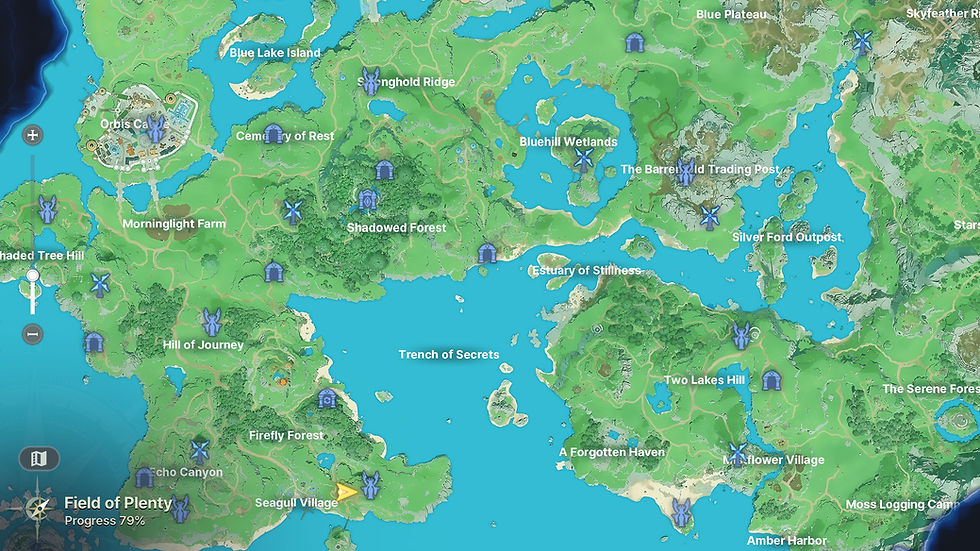
In order to reveal more of the map, you have to follow Alvwyn’s questline, which requires you to activate ancient devices known as Eona’s Legacy. They remind me of the syncing towers in Assassin’s Creed, which reveal the surrounding area. Most of these are completed by simply locating them on the map and talking to Alvwyn at the location. Some have rune puzzles associated with them, and some have a special dungeon (more about them in the dungeon section). Finally, when you activate a tower, you can use your familiar from the top of the tower to traverse great distances in the direction it’s facing. Once unlocked, you can fast travel to these locations.
If one of your characters happens to faint, or you simply want your party to be full health again, you have to receive Goddess’ Blessing by praying at a Statue of Organa. Your starting one is in the capital, but others around the world are damaged, and parts have been scattered around them. Upon finding the parts, bring them back to the statue to lower your cooldown for healing, and you unlock even more fast travel locations.
Story
The main character in the story is Lute, and his group of mercenaries, named the Johnny Mercenaries. We join them in their desire to become the best mercenary group in the land. Solve quests from the mercenary guild, Organa order, King’s royal palace, or the Amber trading company and climb the ranks in order to reach new unlocks. (Your characters will be capped at certain story moments, which you will need to complete to be able to further improve)
I don’t like to spoil the story too much because I always believed a good story is an essential part of the game, but here’s a quick summary: 60 years ago, a group of heroes defeated the Dragon and were known as the Six Heroes. Now, a new threat looms around the corner, and with most of the Six heroes gone or no longer in their prime, it is up to us to find the solution.
As you play, more of the story is revealed, both in the current time and the past, and the game ends on a bit of a cliffhanger - likely suggesting a DLC will be coming.
Characters
In every RPG, one of the funnest things to do is “create” your own character. In this game, that’s not possible visually; however, with 19 available options, each one being unique, I think we can agree there’s no point in creating new ones. I’m not gonna list them all cause there’s no point - play the game and find the ones you enjoy most. Personally, I used a team of Lute, Ornette and Castella for the majority of the game; only near the end did I switch Castella for Kalien.

A funny interaction where you can have a character equipped and still be able to talk to them
All characters have an element; for example, Kalien has fire, Cerese frost, Johnny poison… This is important for Karma - Karma is a special equipable whose additional effects activate only if the element matches that of the character.
Combat-wise, all characters have the same inputs: basic attack, jumping attack, dodge, dodging attack, 2 active abilities, and 2 signal abilities (which can be activated when certain conditions are met, usually filling up the element bar of the boss). These abilities can be upgraded by awakening the character in the awaken panel.
Last but not least, all characters can be improved with equipment. There are 5 slots for every character, and set bonuses are in effect at 2 or 3 per set, allowing for mixing and matching. Equipment with more stars has additional effects and can be leveled up more. 5-star equipment also has an unlockable rune slot for further customizing and improvement.
Combat
In many RPGs, the combat is the make-or-break for the success of the game. And the combat here is FUN. You play as a three-man team but only control the active character. You can freely switch between them (with a small cooldown on use, of course). Upon filling the element bar, you are given the option to combo abilities from different characters who then become the active one. In the case of combo switching, the cooldown is avoided.
Optimal gameplay consists of using a character, filling that element, switching to a different one to fill their element as well, then comboing massive abilities for insane damage. Certain characters work better with a certain team, and a good combo team will always be better than one strong character and 2 random ones.
Dungeons

Dungeons are levels within the game. As you complete a certain difficulty, the next one becomes available and so on. There are many types of dungeons in the game, so let’s quickly mention them all:
● Normal
These are the dungeons you can find on the world map and have to be unlocked before attempting them. Rewards for completing these are usually standard equipment and some minor materials.
● Trait
Trait dungeons (actually it’s just the one dungeon, but you enter it for different elements) present a challenge arena. Scaling depends on the difficulty chosen, as do the rewards. Here you can farm trait stones, which you use when crafting new equipment and/or when your Karma is ready for a breakthrough.
● Currency
These dungeons are the ones you will be completing the most; they provide a significant amount of predetermined resources. There is a dungeon for each of the main upgrade materials. The final currency dungeon unlocks just before the last story mission and will provide the best upgrade materials for everything (highly recommended to farm this if you're trying to upgrade additional characters)
● Hunt
Hunt dungeons are basically Boss fights in a dungeon environment. There are 6 named monsters with 5 difficulties each. Rewards for these are Hero Growth materials as well as Monster materials used to upgrade hero skills. Greater difficulties naturally provide more of these materials.
● Raid
Only 2 raid dungeons exist as of now. These are highly difficult, multi-level hard boss fights which repeat the “same” difficult Origin Dragon fights from the story. These are important as they are the primary way to receive runes.
● Platformer
These are slightly different from the rest. There are only 3 of these, and they have no combat within themselves. You have to complete a platforming challenge instead and, upon completing them, unlock the corresponding Eona’s Legacy tower.
These are not visible in the mercenary guide
Miscellaneous
There is a lot of stuff to do in the game itself. You can spend hours trying to find all chests in the open world, trying to locate and complete the Marmot King’s challenges, or solve all the puzzles in the ruins around the world. Some of the chests are free to open when found, others require a key, some might require you to defeat nearby enemies first; the rarest ones are so hidden that you need to find a treasure map first - marking the location of the chest. In addition, chests vary by type, from simple wooden ones to beautiful regal red ones.

Marmot King’s mini-games unlock upon completing his side story. There are several types of these games: whack-a-mole (or a marmot in this case), dodge attacks for a limited time, find marmots scattered around a designated area, or fly on your familiar to the finish line. They always reward a red chest.
Puzzles are another way to sink time in the game. They usually reward a blue chest upon completion. Some are variations of push/slide puzzles, and a lot of them require you to locate and bring something to activate 3 pressure plates to spawn the chest.

Positives
● Visually stunning
● Fun combat
● All characters can be unlocked with gameplay
● Lots of content (around 50h for me)
● Engaging story (even with the bad translations!)
Negatives
● Only Korean voices
● AI translation to English (and bugs that come with that)
● Unfinished story (in certain places at least)
● Day 1 DLC - never a good sign
● Pointlessly grindy achievements
Video, Audio & Sound
The game looks amazing, with very high-quality details on all of the characters, familiars, world… All of the animations were engaging, combos were satisfying, even the bosses had great designs. In particular, I enjoyed smooth story transitions into gameplay.

The music in the game is very nice; it really feels like you are in an anime, which I feel like was the point. Great job on that. As far as the sounds go, only Korean voices exist currently, and I can't say much about it as I don't speak Korean, but it feels good.
Other sounds in the game are done amazingly; the character voice lines when comboing / switching are solid, mining sounds heavy, attacks feel like they carry weight.
One issue I had with the sound is that some of the quests are not voiced over, which can take you out of the story… Not a big deal for me, but it might bother some people.
Personal Thoughts
I love open world games and as such had an amazing time exploring the continent of Orbis. The story was interesting enough, and I had a feeling like I was actually playing a season of an anime (due to the witty characters and discussions; it personally felt like KonoSuba - for those who know). It was fun to learn about the characters, world, history, and complete the journey these developers created. I look forward to more games in the future!
Conclusion
The game tries to be a “cooler” Phasmophobia and fails. I wasn’t expecting much and still ended up disappointed. I would not recommend it.
Factors | Rating | Description |
🎮Gameplay | 9/10 | Great, fluent, fun |
🎧Music | 8.5/10 | Very adequate |
💲Price | 8/10 | For $30 fair price, day 1 DLCs is not good |
🎰Overall Rating | 8/10 | Just shy of a phenomenal game |
Rating: 8/10
Gaming PC Specs
CPU: I5 14600 KF GPU: Nvidia RTX 5070
RAM: 32GB of DDR5 @5600Mhz


